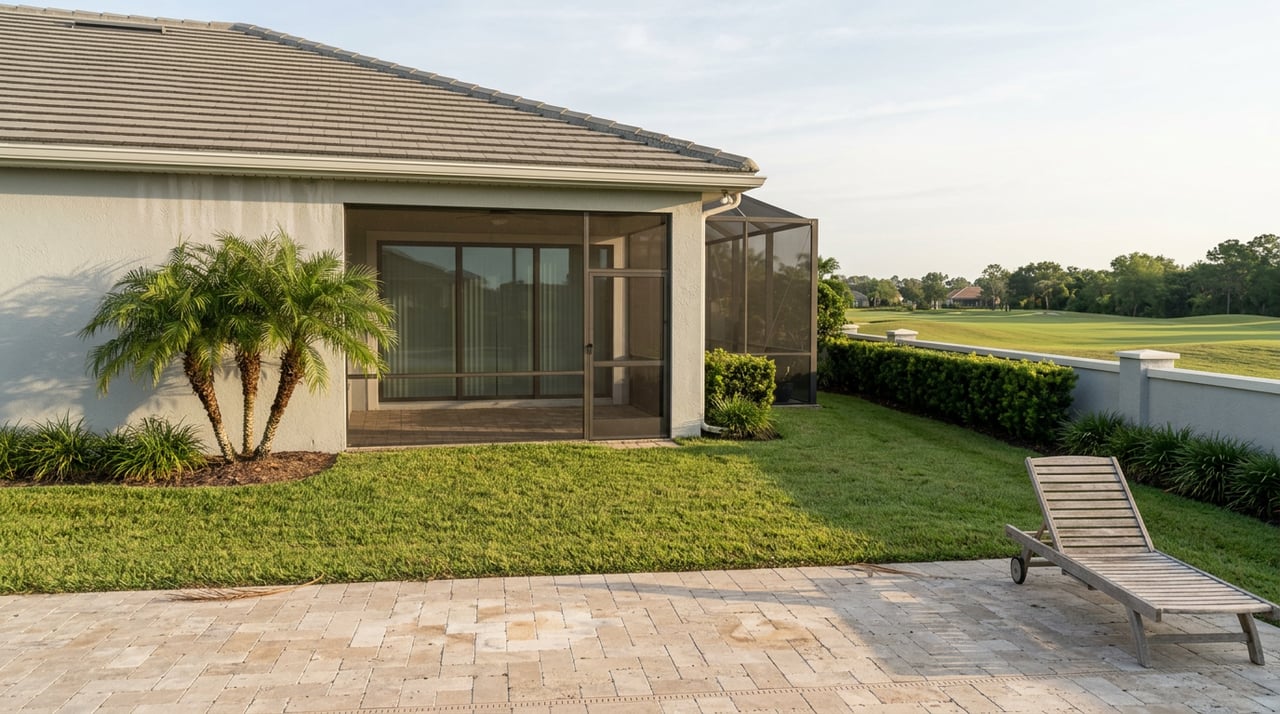
In December 2025, a buyer closed on a brand-new villa at 1101 Fields Court in the Village of Edenfield, paying $300,400. Sometime after that, a lanai went up on the side of the house. The contractor pulled a building permit from Sumter County, which is exactly what a careful homeowner would expect a licensed contractor to do. In August 2026, a hearing at the Brownwood District Office ordered the lanai removed. The contractor acknowledged that the Architectural Review Committee step had been skipped.
That case is the clearest illustration of something most buyers moving here have never been told: in The Villages, county permitting and community approval are two separate tracks, and passing one does not clear the other. The permit search a diligent Florida buyer runs before closing will not surface an ARC problem, because an ARC problem never touches the county's records at all.
Two approvals, one house, no overlap
The Villages Community Development Districts require an Architectural Review application before any exterior change. Not just additions. Repainting, porch enclosures, pergolas, arbors, trellises, coloring a driveway or walkway, landscaping changes, and removing a tree greater than four inches in diameter. The ARC reviews more than 300 applications a week, meeting Wednesday mornings at 3571 Kiessel Road. Sumter County Building Services, working out of 7375 Powell Rd in Wildwood, is a separate government reviewing a separate question: whether the structure is safe and built to code.
A homeowner can satisfy one and fail the other, and the failure is invisible from the street.
Approval also comes with conditions that outlive the paperwork. In a case heard in April 2026, owners of a home in the Fairwinds Villas in the Village of St. James had applied to the ARC for a reroof and were approved, but with a stipulation: the shingle had to match the color used at original construction, or something closely resembling it. The roofer installed a color that was neither. Community Standards found the home out of compliance and the board gave the owners 45 days before daily fines of $50 would begin. The homeowners did the right thing at every step a reasonable person would recognize as a step. The roof still has to be redone.
What transfers at closing is the condition, not the case
Here is the mechanism that changes how you should shop.
Deed compliance enforcement in The Villages is, in the districts' own description, entirely complaint driven. Nobody drives the streets writing tickets. A feature can sit in a front yard for fifteen years, plainly outside the Architectural Review Manual, and generate nothing at all, because no one has picked up the phone.
When the house sells, the enforcement case does not automatically follow the new owner. By district practice, as one CDD chairman explained when a long-running case closed on transfer, a fresh complaint has to be received before a new case can be opened against the buyer. The paperwork resets. The landscaping, the rock, the driveway color, the enclosure does not.
So the buyer inherits an asset with an embedded contingency. What you are actually purchasing is not a violation and not a clean bill of health. It is a probability, and that probability converts to a bill on a schedule nobody controls.
Two 2026 cases show what that conversion looks like. Michael and Mary Lou Mastin, of 3357 Fountainhead Ave. in the Village of Collier, bought their home in 2017 for $320,000. They maintain the landscaping was already in place when they bought it. Someone reported it in 2024. As of August 2026 the fines stood at $52,394 and were still climbing at $50 a day, with CDD 10 having spent $8,832 in legal fees pursuing the matter. In July 2026, Kathleen Stringer, a homeowner in the Village of Piedmont, was found in violation for landscaping extending into the road right-of-way. Her position was that it had been there since the home was built.
Both owners may be entirely correct about the history. Neither answer is a defense. The enforcement question is whether the condition exists now, and the person who owns the house now is the person who answers for it.
Asked in a 2023 CDD 3 discussion about buying a patio villa with stone landscaping, knowing that a single complaint could cost the new owner thousands to remove the rock and lay sod, Supervisor Steffan Franklin, a former ARC member, said he would tell them not to buy the house.
The same yard carries different risk in different districts
Because enforcement runs on complaints, the practical exposure attached to an identical condition is not uniform across the community. It depends on who can file, and how easily.
CDD 5 ended anonymous complaints several years ago after supervisors concluded a handful of people were submitting them in batches of 25 or 30. District 2 now requires a complainant to be a resident of that district and to provide name, unit and lot number, and phone number. Other districts have not made that change.
This is the part that portal listings cannot price. Two homes with the same unapproved feature, one in a district that accepts anonymous reports and one that does not, are carrying meaningfully different odds. Ask which district a home sits in and what that district's complaint rule is. It is a fair question and the answer is public.
Once a complaint lands, the ladder is documented and it moves:
| Stage | What happens |
|---|---|
| Complaint received | Community Standards inspects and contacts the owner |
| Notification | Up to three notices, the last setting a hearing date |
| Hearing | Heard by the district Board of Supervisors or a Deed Compliance Hearing Officer |
| Order of Enforcement | Typically 7 to 45 days to cure, depending on the issue |
| Fines | $150 initial fine, then $50 per day until compliant |
| $1,500 threshold | Case referred to District Counsel |
| District maintenance | For overgrowth, the district may maintain the property at $250 per occurrence |
| Escalation | Lawsuit, injunction, or a lien against the property |
Why this is a negotiable item right now, and was not in 2022
Timing matters here more than most buyers realize.
Reporting published by Villages-News on Sept. 6, 2026 put the median listing price in The Villages at $377,784 for August 2026, down close to 2 percent from $385,316 in August 2025, and the fourth consecutive annual decline from a 2022 peak of $436,850. In that same reporting, a senior economist tracking the community noted that a home now typically sits about 60 days, double the 30-day median of 2022.
Read that as a negotiating calendar, not a headline. In 2022, raising a compliance question meant losing the house to the next offer. In a 60-day market, an inspection period long enough to request ARC records is something a seller will generally accept, and an unresolved issue discovered in week three is a price conversation rather than a reason for the buyer to walk quietly.
The gap is not closing on its own. CDD 5 Board Chairman Gary Kadow called in August 2026 for compliance inspections prior to resales, saying elected officials have an obligation to find a solution and urging the developer, Properties of The Villages, outside real estate companies, and district government to work it out together. CDD 7 supervisors raised the same concern in 2024, with board counsel floating a fee-based voluntary program. No such program exists today. Until one does, verification is the buyer's job.
Before you write the offer
- Get the Declaration of Restrictions for that specific unit. Restrictions vary by district and by unit. The unit and lot number appears on the Villages ID card and the declarations are downloadable by unit.
- Read the Architectural Review Manual for that district, not a general summary. The rock-versus-sod rule for patio villas and the acceptable driveway colors live in the manual, and manuals differ.
- Request the ARC approval history and any open deed compliance case. Community Standards can be reached at 352-751-3912, or by email at [email protected] and [email protected]. These are records of a Florida governmental entity.
- Walk the property and list every modification you can see. Enclosed lanai, birdcage, extended patio, painted driveway or walkway, decorative rock, a tree that is clearly gone, a roof that does not match the neighbors. Then match each item to both an approval and a closed county permit.
- Check the permit side separately through Sumter County Building Services for homes in Sumter, and the appropriate county for homes in Lake or Marion. A permit is valid 180 days past issue or last approved inspection, which is how work gets finished under a permit that quietly expired.
- Understand what the contract does and does not cover. The standard Florida HOA and community disclosure makes the seller responsible for fines imposed as of the closing date. A condition that is out of compliance but has never been fined is not a fine. That is precisely the exposure described above, and it is worth having your closing attorney address in writing.
If you are the one selling
The same mechanism runs in reverse, and it is easier to manage from the seller's side. In July 2026 a home in the Village of DeLuna was listed at $575,000 while an active deed compliance case was pending, with the listing making no mention of it. Villages-News picked it up. In a market where buyers have time to read, that is not a detail that stays buried until closing.
Florida sellers owe disclosure of known material facts that a buyer cannot readily observe, and that obligation survives an as-is contract. Pulling your own ARC history before you list, curing what is curable, and documenting what is not costs less in September than it costs during a buyer's inspection period in November. Your attorney should advise you on your specific disclosure obligations; my job is to make sure nothing surprises either side at the table.
Questions buyers actually ask
If the previous owner built it, am I really responsible? The enforcement action addresses the condition of the property as it exists, and the owner of record answers for it. Two homeowners argued the prior-owner point in hearings this year. It did not resolve the matter for either of them.
Does an existing fine follow the house to me? Unpaid fines can lead to a lien against the property, and districts have pursued liens and lawsuits. This is exactly why the title work and an ARC records request should happen in the same week, not in sequence.
Do I need ARC approval to paint my own driveway? Yes. Coloring or painting a driveway or walkway requires an application, and manuals restrict which colors are acceptable. This is one of the most common surprises for new residents.
How long does ARC approval take? The committee has long worked on a weekly cycle, with applications submitted by noon Thursday heard the following Wednesday and results posted the day after. Confirm the current cutoff with Community Standards, then plan the sequence so approval comes before the contractor's start date, not after.
Buying here should feel like the beginning of something good, not a paperwork ambush three months after you unpack. If you are under contract, thinking about writing an offer, or preparing to list a home you have loved for twenty years, let's go through the property together and get the records pulled before anything is at stake. Reach out to Caroline Fromkin for your free home valuation or a no-obligation consultation.